
Planning a hybrid event is a little like hosting two events at once, which, technically, it is. You have people in the room, people joining online, speakers in different locations, technology doing its best to behave, and an event team tracking approximately 47 things at the same time.
A full room is encouraging. A busy chat is great. But neither tells the whole story. To understand your hybrid event ROI, you need to look beyond attendance and measure what your event helped you accomplish.
Today we’ll cover the most useful hybrid event KPIs, how to compare in-person and virtual audiences, and how to turn event data into better decisions for your next event.
What is hybrid event ROI?
Hybrid event ROI is the value your event generates compared with the resources invested in producing it.
A basic ROI formula looks like this:

The “return” will look different depending on your event goals.
For example, your event may be designed to:
Generate leads
Educate customers or employees
Raise money
Build brand awareness
Create networking opportunities
Launch a product
Strengthen community
Support internal communication
That means there is no single magic number that determines whether a hybrid event worked. The right KPIs depend on what you wanted the event to achieve in the first place.
Start with your event goals
Before reviewing dashboards and spreadsheets, revisit your original goals.
Ask:
What did we want attendees to do?
Who was the event designed for?
What would success have looked like?
Which outcomes mattered most to leadership, sponsors, speakers, or attendees?
If your main goal was lead generation, focus on registrations, qualified leads, meetings, and conversions.
If your goal was employee engagement, look at participation, survey responses, questions asked, and follow-up actions.
If your event was a fundraiser, donations and donor retention may matter more than the number of people watching online.
The most important metric is the one connected to the purpose of your event, and not simply attendance numbers or total hours viewed.
1. Registration and attendance metrics
Registration is an important starting point, but it is not the finish line, and registration metrics will look and feel different depending on the nature of your event.
Important metrics to track:
Total registrations
In-person registrations
Virtual registrations
Attendance rate
No-show rate
Session attendance
Repeat attendance across multiple sessions
Average time attended
Some platforms will have built-in metrics to measure registration vs. attendance, but a simple attendance rate can be calculated using the following:
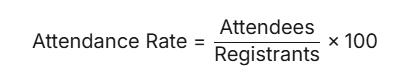
When reviewing these metrics, be sure to evaluate each audience separately. A 70% attendance rate for your virtual audience and a 90% attendance rate for your in-person audience may tell you that the two groups had different expectations, or it could be tied to something as simple as needing to revise your reminder strategy.
Also pay attention to session-level attendance. If your keynote attracted a large audience but breakout sessions were nearly empty, that is useful information for planning your next agenda.
2. Engagement metrics
Attendance tells you who showed up. Engagement helps you understand whether they participated.
For virtual attendees, track:
Chat messages
Poll responses
Q&A submissions
Reactions
Virtual networking activity
Session clicks
Resource downloads
Questions answered
Time spent on the platform
For in-person attendees, track:
Session attendance
Questions asked
App activity
Networking meetings
Sponsor booth visits
Scavenger hunt or gamification participation
Survey responses
Workshop participation
Do not treat engagement as a competition between audiences. In-person and virtual attendees participate differently, and a successful ROI will look different for both.
Someone attending in person may be networking between sessions, while a virtual attendee may be asking thoughtful questions in the chat. Both behaviors can indicate a successful experience.
3. Audience retention and drop-off
One of the most useful virtual event metrics is audience retention.
Retention shows how long attendees stayed and when they left. If a significant number of viewers disappear ten minutes into a session, it’s worth exploring why.
Possible causes include:
The session ran too long
The content did not match the session description
The presenter was difficult to hear or see
The virtual experience felt passive
There was a technical issue
Attendees only joined for one specific segment
Retention data can help you improve future programming. For example, you might discover that your audience prefers 30-minute sessions with a live Q&A instead of hour-long presentations.
For hybrid events, compare retention by audience type. If your in-person audience stayed engaged while virtual viewers left early, the virtual experience may need more interaction, more engaging virtual production, or better pacing for those not in the room.
4. Sponsor and exhibitor performance
Sponsors want more than logo placement and a shout-out. They want meaningful visibility and measurable opportunities.
Useful sponsor KPIs include:
Booth visits
Sponsor page views
Resource downloads
Connections made
Meetings scheduled
Chat activity
Leads generated
Session mentions
Post-event content views
For hybrid events, sponsors often have a unique opportunity to connect with both audiences. An in-person attendee might visit a booth, while a virtual attendee can download sponsor resources, view relevant media or schedule a meeting online.
Report both types of activity so sponsors can see the full value of participating.
5. Content performance after the event
One of the biggest advantages of virtual and hybrid events is that the content can continue working after the final session ends.
Important metrics once your program is available on demand:
Recording views
Average watch time
On-demand session completion
Replay downloads
Social media engagement
Podcast or video clips created from the event
Follow-up article traffic
Resource downloads
A session that had modest live attendance may perform extremely well on demand. That does not make the session unsuccessful—it may simply mean specific content has a longer shelf life, or that the original session was broadcasted at a difficult time in the schedule.
This is where event production and content strategy can work together. A well-recorded session can easily become much more than a replay URL:
Short video clips
Social media posts
Blog content
Email content
Training materials
Sales resources
Podcast episodes
The live event may be over, but your ROI continues when content can be replayed, repurposed and revisited over time.
6. Attendee satisfaction
Numbers tell you what people did. Feedback helps explain why.
Use a short post-event survey to ask questions like:
How would you rate the overall event?
Was the event easy to access?
Was the content useful?
Did the technology work well?
Did you feel included in the event experience?
What was your favorite session?
What could be improved?
Would you attend another event from us?
How likely are you to recommend this event to a colleague?
Keep the survey short, simple to complete and relevant to your important questions and metrics. If it takes longer to fill out and requires more interaction than some of your sessions, people may decide to skip it.
7. Cost-per-attendee and cost-per-lead
Your total event budget matters, but averages can make the data easier to understand.
Calculate:
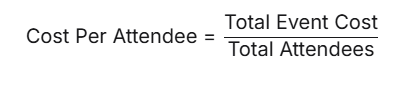
You can also calculate:

Compare these numbers across event formats, but be careful not to judge purely on cost.
A less expensive event is not automatically better if it produces fewer qualified leads, lower engagement, or a poor attendee experience. Sometimes the extra investment in professional production, moderation, accessibility, online platforms or technical support is the secret sauce for making an event successful and effective for all attendees.
8. How to compare virtual and in-person audiences
Avoid putting both audiences into one large bucket. Instead, create separate reports for:
Registration
Attendance
Engagement
Session retention
Networking
Content consumption
Satisfaction
Conversion
Then compare the results carefully. The goal is not to declare a winner, but rather to understand how each audience experienced the event and where each format performed best.
Measuring hybrid event ROI is not about one impressive number that you’re focused on achieving. It’s about connecting your event activity to your actual goals. Look at who attended, how they participated, what they learned, what they did afterward, and whether the event created value for your organization based on all the metrics available.
And remember: a successful hybrid event is not simply an in-person event with a camera pointed at it. It is a carefully planned experience for two audiences, with the technology, content, and engagement strategy to support both.
Need help figuring out what matters most for your next virtual or hybrid event, and how to get there? Book a free 30-minute consultation with Revent Consulting, and let’s turn your event data into useful next steps.